

Today, I want to share the concept of constraint and how it can be applied to your goals, whether you wish to lose weight or simply eat better.
A constraint is a limitation or restriction you place on yourself to make your life easier.
While the idea of a constraint might seem inhibiting at first, when placed appropriately, it can actually be quite liberating. In fact, it often creates more freedom in your life, not less.
And here’s the key: you’re choosing the constraint.
It’s not something handed down by a higher authority. It’s something you’ve decided for yourself.
You’re the boss.
An Elegant Solution to a “Problem”
You can also think of a constraint as an elegant solution to a recurring problem.
Take calorie counting, for example.
Most people find it tedious, turning meals into a math equation.
However, to lose weight, we know that a calorie deficit is required—whether through consuming fewer calories, increasing physical activity, or a combination of both.
Now, consider a constraint that accomplishes the same thing without needing to track calories.
For instance:
- Not snacking between meals
- Avoiding food after a particular time in the evening
Both of these have the potential to reduce your calorie intake without requiring any tracking. You simply eat a little less, without having to think about it all the time.
Simplicity and Focus
The beauty of constraint is that it brings simplicity and focus to your everyday life. It reduces decision fatigue, saves time, and preserves energy.
And chances are, you already have constraints in place without even realizing it.
Think about shopping:
- Maybe you stick to certain clothing brands that you know fit well
- Or you shop at just one grocery store for convenience
Then there are time-based constraints:
- Perhaps you’ve decided not to work past 6 p.m.
- Or you keep weekends free for rest and personal time
Business is no different.
In my own practice, I constrain to just one offer: private 1:1 coaching.
I don’t currently run group programs, memberships, or host a private community.
That constraint allows me to serve at a higher level and go deeper with each client. I can give more because my focus isn’t scattered.
It’s not to say I won’t offer other things in the future, but right now, this constraint serves me and my clients.
Unconscious Constraints
We also have constraints operating in the background that we may not be fully aware of.
For instance, think about what you share publicly.
You probably have a personal boundary around what’s private versus what you’re willing to share with others or post on social media.
Or take something like smoking.
If someone offers you a cigarette and you don’t smoke, your answer is automatic: No thanks. There’s no struggle or inner negotiation.
That’s the power of a well-established constraint. It removes the mental load of constant decision-making.
Weight Loss / Eating-Specific Constraints
Placing clear, intentional constraints around food is a powerful way to reduce decision fatigue and simplify your choices, especially if you’re trying to lose weight or eat more intentionally.
Here are a few examples:
Flour
One helpful constraint for clients looking to reduce their intake of processed foods and refined carbs is to limit—or eliminate—flour.
By removing flour, you automatically avoid a wide range of ultra-processed foods like:
- Noodles
- Bread
- Crackers
- Baked goods
Of course, you can make exceptions to fit your lifestyle:
- Perhaps you only allow flour if you’re baking from scratch yourself
- Or you avoid it during the week, but make an allowance for special weekend meals
- Or maybe you’re fine with certain types of flour, but not others
It’s not about a rigid rule. It’s about setting a limit that feels supportive.
Alcohol
Another great example is setting a constraint around alcohol.
If you’ve decided you’re not drinking right now, and someone offers you a glass of wine at dinner, you already know your answer.
But again, you can customize your own limits:
- Maybe you allow yourself two drinks per week
- Or you save alcohol for planned social events
- Or you opt out entirely for a certain period of time
It’s your decision.
Timed Eating
You can also use constraints around when you eat.
For example:
- No eating after 8 p.m.
- No snacking between meals
But it’s not:
“I’m not allowed to eat after 8 p.m.”
It’s:
“I’ve chosen not to eat after 8 p.m. because I know it’s usually unnecessary snacking. I feel better and sleep better when I stop eating earlier.”
That’s the difference between an arbitrary rule and a self-chosen standard.
Choose What Serves You
It’s not about whether avoiding flour, alcohol, or snacking is the right move.
It’s about what makes sense for you—what simplifies your life and supports your goals.
~ Elaine
P.S. If you’re seeking high-level support to help you permanently lose weight, overcome your food struggles, and enhance your overall health, then my program may be a great fit.
Get all the details here and apply for a Clarity Consult so we can make sure it’s a great fit.

Hi! I’m Elaine, a Certified Nutritionist and Master Certified Health Coach. I support women in achieving their health and body goals while prioritizing a peaceful and balanced relationship with food.
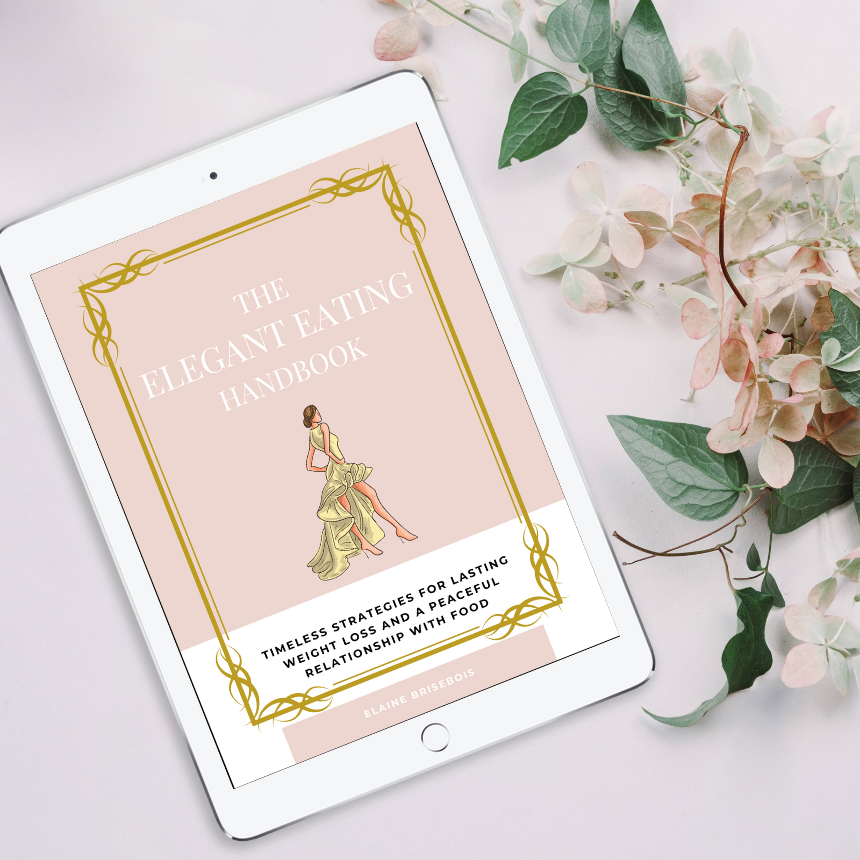
Get a free copy of my handbook!
The Elegant Eating Handbook: Timeless Strategies for Lasting Weight Loss and a Peaceful Relationship with Food.