
Let’s talk about something important.
When it comes to long-term fat loss, one of the biggest predictors of success is whether you can manage your hunger and appetite while in a calorie deficit.
Because when you eat less, your body notices.
BUT…
There’s a big difference between feeling a “little hungry” between meals (completely normal)… and feeling like you could eat your arm by 10 am.
Real Hunger vs. Emotional Cravings
If you’re waking up hungry, going to bed hungry, and thinking about food nonstop, that’s your body sending a clear signal that it’s not getting enough fuel.
And to clarify, I’m not talking about emotional hunger—the kind that shows up when you’re bored, stressed, or craving comfort after that awkward conversation with your colleague (say, from a batch of homemade cookies or a pitstop at Starbucks).
I’m talking about real, physiological hunger: the kind that stems from an energy deficit and shows up as difficulty concentrating, irritability, headaches, or an intense preoccupation with food.
If this sounds familiar, here are three common mistakes that might be making it harder to stay consistent—and what to do instead.
1. Your Calorie Deficit Is Too Large
Trying to lose weight quickly doesn’t make you more dedicated—it usually just makes the process harder to sustain.
Research suggests most people do best losing about 0.5–1% of their total body weight per week.
For example:
• A 150 lb person → 0.75–1.5 lbs/week
• A 200 lb person → 1–2 lbs/week
(Your current body composition matters, too: if you have more fat to lose, you might see faster progress early on. But if you’re already leaner or closer to your goal weight, a slower rate—around 0.5 pounds per week—is often ideal. Pushing beyond that usually means dipping your calories too low, which can backfire.)
Over-restricting can increase hunger, drain your energy, and make you more vulnerable to muscle loss or rebound eating.
Instead, a modest deficit of 250–300 calories a day is often enough to see progress, without compromising your focus or mood. Again, this is especially important if you have less fat to lose, when a slower, more strategic approach helps protect muscle mass and makes the process more sustainable.
2. Your Meals Aren’t Designed to Keep You Full
You can hit your calorie target and still feel unsatisfied if your meals aren’t supporting satiety.
What helps is volume—foods that take up space in your stomach and slow digestion.
Think:
✔️ Vegetables and fruits
✔️ Legumes and whole grains
✔️ Lean proteins
These foods stimulate satiety hormones like GLP-1, peptide YY (PYY), and cholecystokinin (CCK)—your body’s natural fullness signals.
Build meals that require chewing and take time to eat. You’ll feel fuller, longer.
3. You’re Eating Inconsistently—or Not Enough
If your meals are too small, too sparse, or too low in carbohydrates, your body can interpret this as a sign of stress.
When this happens, cortisol (your body’s primary stress hormone) can rise, leading to:
- Disrupted sleep
- Increased cravings (especially for sugar and fat)
- A higher likelihood of fat storage, especially in the abdominal area, occurs when overeating follows periods of restriction.
If you often feel wired at night, irritable, or constantly needing snacks, it may not be a willpower issue. It could be your nervous system sounding the alarm.
The fix?
Regular meals, adequate carbohydrates, sufficient total calories and food volume, and quality sleep. These help your system stay calm and steady, so your body doesn’t feel the need to compensate later.
Bonus Tip: You Might Just Be Dehydrated
Your brain regulates hunger and thirst in the same area.
Sometimes, what feels like hunger is just mild dehydration.
This doesn’t mean “just drink water instead of eating,” but staying hydrated between meals can help reduce unnecessary snacking or false hunger cues.
Try:
- Sparkling water or non-caloric beverages
- Water
- Herbal tea
The Bottom Line: Hunger Shouldn’t Derail You
A little hunger is expected when you’re in a fat-loss phase.
But if it’s affecting your focus, energy, or ability to stay consistent, it’s worth troubleshooting.
Often, a few small changes—such as adjusting your deficit, improving meal composition, or regulating mealtimes—can make all the difference.
P.S. Ready to lose weight in a way that feels sustainable—without living in a bubble or missing out on life?
Here’s who I work with:
🔹 Women who want to lose weight without cutting out bread, wine, or dessert indefinitely
🔹 Women who are tired of food guilt, obsessive tracking, and the mental exhaustion that comes with always trying to “get it right”
🔹 Women navigating perimenopause, menopause, or confusing body changes who want a plan that works with their physiology
🔹 Women who want to feel calm and in control around food—whether they’re at a restaurant, on vacation, or standing in front of the fridge at 9 pm
If that sounds like you, my 1:1 coaching program might be the next right step.
👉 Apply here to get started.

Hi! I’m Elaine, a Certified Nutritionist and Master Certified Health Coach. I support women in achieving their health and body goals while prioritizing a peaceful and balanced relationship with food.
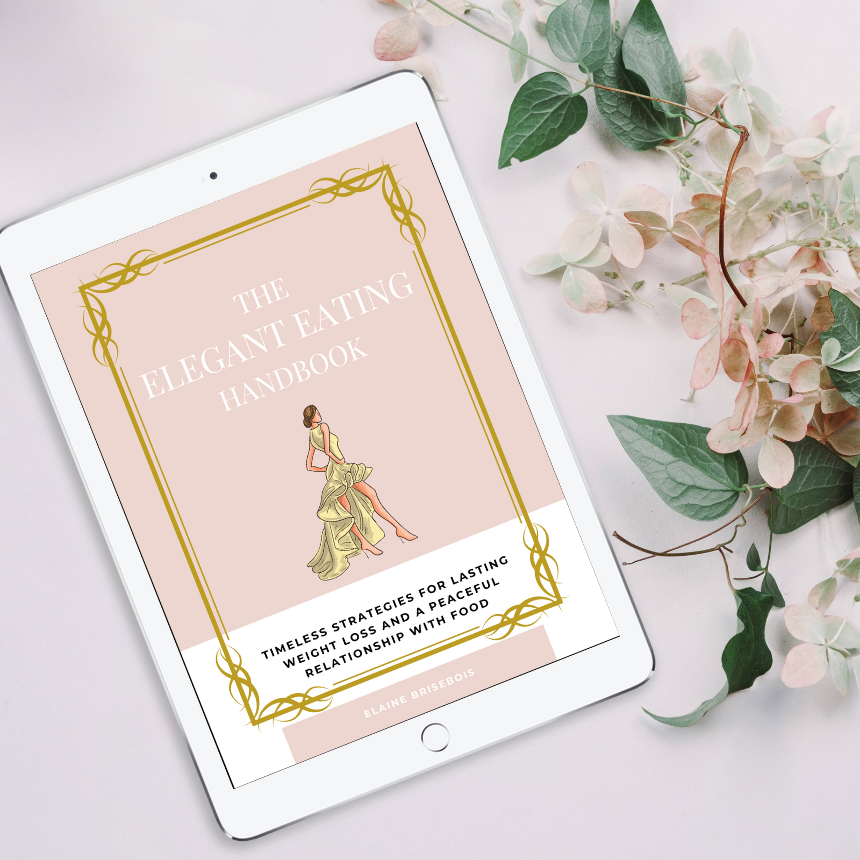
Get a free copy of my handbook!
The Elegant Eating Handbook: Timeless Strategies for Lasting Weight Loss and a Peaceful Relationship with Food.