
I hear it all the time…
“What if I slip up?”
“What if I go back to the old me?”
“What if this doesn’t last?”
And I get it.
When you’ve spent years coping with food, eating on autopilot, or struggling to stay consistent, it’s hard to picture yourself as someone different.
Even when you are doing things differently—planning ahead, making intentional choices, following through—it can still feel like you’re just going through the motions.
In the Beginning, It Doesn’t Feel Natural
At first, you’re not yet the person who does these things instinctively.
Whatever “the thing” is for you, it doesn’t feel automatic. Not yet.
It might look like:
- Planning your food instead of winging it
- Eating at the table instead of on the couch
- Working out regularly
- Choosing a walk over zoning out with a screen
- Saying no to wine on a random night
- Prepping meals ahead of time
- Actually scheduling the grocery shop
- Leaving food behind instead of finishing it “just to get it out of the house”
At first, it all feels awkward.
Like you’re pretending.
Like you’re borrowing someone else’s routine.
But with time and repetition, those choices start to feel like yours—because they are.
The Real Sticking Point? Your Identity
Most people believe the problem lies in the habit itself.
However, often the real disconnect lies in who they believe they are.
Because here’s the truth:
You can’t create a new outcome with the same old identity.
If you still see yourself as “someone who always falls off,” then every slip feels like proof that you haven’t really changed.
But if you start to see yourself as someone who follows through—even imperfectly—then every choice becomes a vote for that version of you.
Your brain is wired to act in line with who you believe you are.
If deep down you still identify as “the fat girl,” “the lazy one,” or “someone who always gives up,” your actions will keep reflecting her, even when you’re trying to do better.
My Story: Setting a Table for One
I remember when this started to click for me.
Back then, I’d often come home after my workday, change immediately into comfy clothes, and eat dinner on the couch in front of the TV. Total autopilot.
But even then, I had this vision of being someone who ate at the table.
Someone who slowed down. Ate mindfully.
Still, I’d think, “What’s the point? I’m eating alone. Who cares?”
It felt like something I’d do later, when life looked different.
Then one night, I decided to try it anyway.
I set the table.
Plated my food nicely.
I think I even lit a candle.
I sat down—just me, no distractions.
And honestly? It felt kind of ridiculous. Like I was playing house.
But I wanted to be the kind of person who eats with intention—even when no one’s watching.
So I did it again. And again.
Eventually, it stopped feeling performative.
Eating on the couch started to feel “off.”
Later, when I met my now-husband, I used to joke that he got the “refined version” of me—because by then, dinner at the table wasn’t something I was trying to do.
It was just who I was.
What Actually Changed?
Your brain runs on predictive coding.
It expects you to keep doing what you’ve always done.
That’s why old patterns feel automatic—even when they’re not serving you.
But when you disrupt that pattern with repetition and intention, your brain begins to rewire itself, forming new neural pathways that make the new behaviour feel more natural over time.
That’s how identity-based habit change happens.
You’re no longer just practicing—you’re becoming.
What About Slipping Up?
You might. Especially when life gets messy.
But here’s what’s different now:
- You’re not spiralling for weeks over a few “off” days
- You’re not slipping back into old patterns without noticing
- You might still want ice cream at 9 p.m., but you’re not driving to the store in a frenzy
Because those choices no longer feel like you.
Not following through doesn’t just slow your progress.
It creates a misalignment between who you want to be and what you’re doing.
And that internal friction? It’s actually a sign that change is happening.
This Is How Identity Shifts
- You act “as if”
- You repeat the behaviour
- Your brain updates its expectations
- The action starts to feel natural
- The identity begins to stick
You go from practicing to becoming.
So when clients say, “I’m scared I’ll go back to my old ways,” I remind them:
If you’ve been practicing a new way of being—repeatedly—it doesn’t just vanish.
You’ve become someone who:
- Makes intentional choices
- Catches herself when she veers off course
- Doesn’t abandon herself when things feel hard
You don’t need to be perfect.
You just need to keep showing up.
And that changes everything.
Ready to Become Her?
This is exactly what we practice inside my 1:1 coaching program.
If you’re ready to become someone who follows through—consistently, confidently, and without starting over every Monday—this program may be a great fit.
You’ll learn how to eat (and live) in a way that aligns with your goals and your real life.
📌 Read the full program details here.
💬 Apply for a complimentary consult here.
We’ll discuss where you are now, where you want to be, and a plan to help you get there.
~Elaine

Hi! I’m Elaine, a Certified Nutritionist and Master Certified Health Coach. I support women in achieving their health and body goals while prioritizing a peaceful and balanced relationship with food.
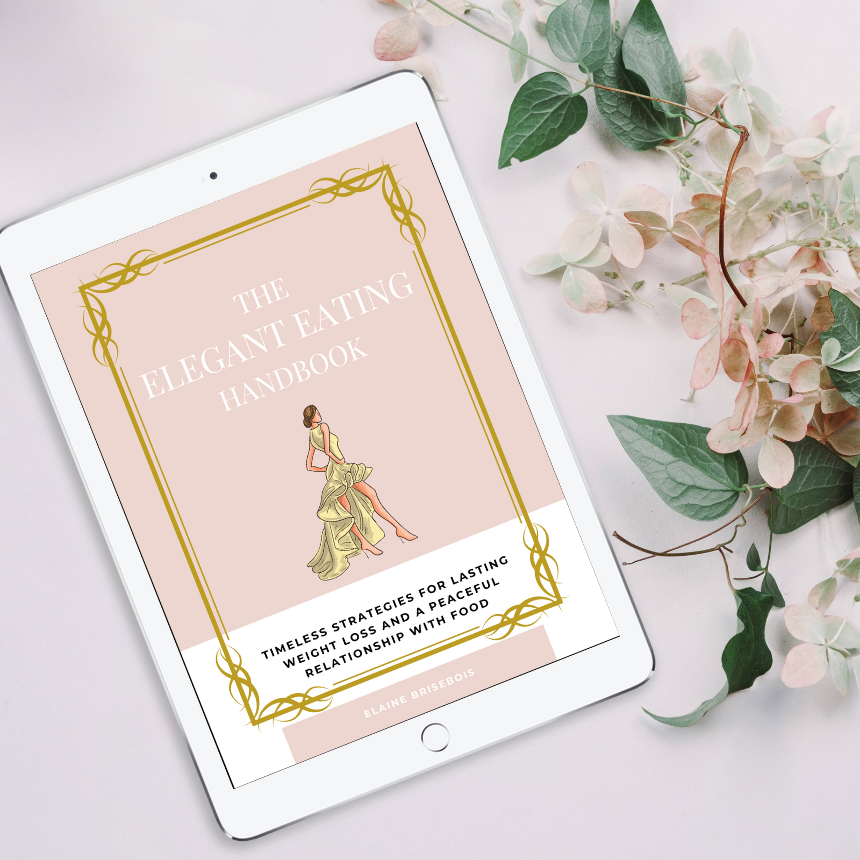
Get a free copy of my handbook!
The Elegant Eating Handbook: Timeless Strategies for Lasting Weight Loss and a Peaceful Relationship with Food.
share with friends
keep reading...