

When you’re trying to figure out what’s working—and what’s not—on your personal food protocol, the simplest and most effective tool is this:
Write it down.
Why a Food Journal Works
Most of us have a pretty short memory when it comes to what we’ve eaten, especially when days get busy.
Even the most health-conscious people tend to overestimate the “good” stuff and underestimate the mindless bites and sneaky exceptions that add up over time.
Keeping a simple food journal helps you:
- Evaluate your habits honestly and accurately
- Stay accountable without obsessing
- Spot helpful patterns (and unhelpful ones, too)
- Make data-based decisions instead of emotional ones
Keep it Simple
Some people love their tracking apps, and that’s totally fine.
But personally? I still love the simplicity of pen and paper.
There’s no tech to learn, no apps to update, no pressure to be perfect.
And no, you don’t need to track every macro, calorie, or measurement.
That’s not the point.
Instead, just jot down:
- A quick, honest description of what you ate
- A rough idea of the portion (if it helps)
- Maybe the time of day or how hungry you felt—only if it feels useful
Sometimes clients prefer to snap a photo instead of writing it down, and that works too. It’s completely optional.
The goal is to keep it simple and doable so you can stay consistent, not perfect.
It Takes Less Time Than You Think
If you’re mainly eating main meals (and not snacking throughout the day), keeping a journal shouldn’t take more than a few minutes.
And the benefits? They compound quickly.
When a client tells me, “That protocol didn’t work for me,” I’ll often ask a few follow-up questions.
More often than not, we discover she wasn’t actually following it consistently.
The food journal becomes our truth-teller.
It gives me the closest thing I have to “eyes on her diet,” and allows me to offer meaningful feedback based on what—and how—she’s actually eating.
Small Adjustments = Big Progress
Often, it’s the little tweaks that make the most significant difference:
✅ Adding healthy fat to lunch reduces afternoon snacking
✅ Eating more carbs at dinner helps you sleep (and prevents late-night cravings)
✅ Capping wine at one glass avoids that slippery slope into chips or sweets
✅ Sitting with an urge—without reacting—builds confidence and self-trust
These are the types of discoveries that come directly from food journal reviews.
Letting Go of Perfectionism
One of the biggest blocks to food journaling?
Perfectionism.
We only want to write things down when we’ve eaten “perfectly.”
We avoid tracking when we’ve gone “off-plan” or emotionally eaten out of stress or boredom.
But here’s what I’ve found over and over again:
The clients who write it ALL down—good days, hard days, messy days—make the most progress.
Because they’re working with real data.
Journaling as a Practice of Imperfection
Tracking only on the days you feel “in control” defeats the entire point of the food journal.
This isn’t about judgment.
It’s just about information.
Data collection.
At the end of the day, your food journal is just a tool to help you understand what’s happening, so you can decide what (if anything) needs to change.
That’s it.
Just information to support your growth.
Want Personalized 1:1 Nutrition & Weight Loss Support?
Within my 1:1 coaching program, I support women in developing sustainable eating habits that feel natural and aligned with their goals, utilizing tools such as simple food journaling, intentional planning, and identity-based habit change.

Hi! I’m Elaine, a Certified Nutritionist and Master Certified Health Coach. I support women in achieving their health and body goals while prioritizing a peaceful and balanced relationship with food.
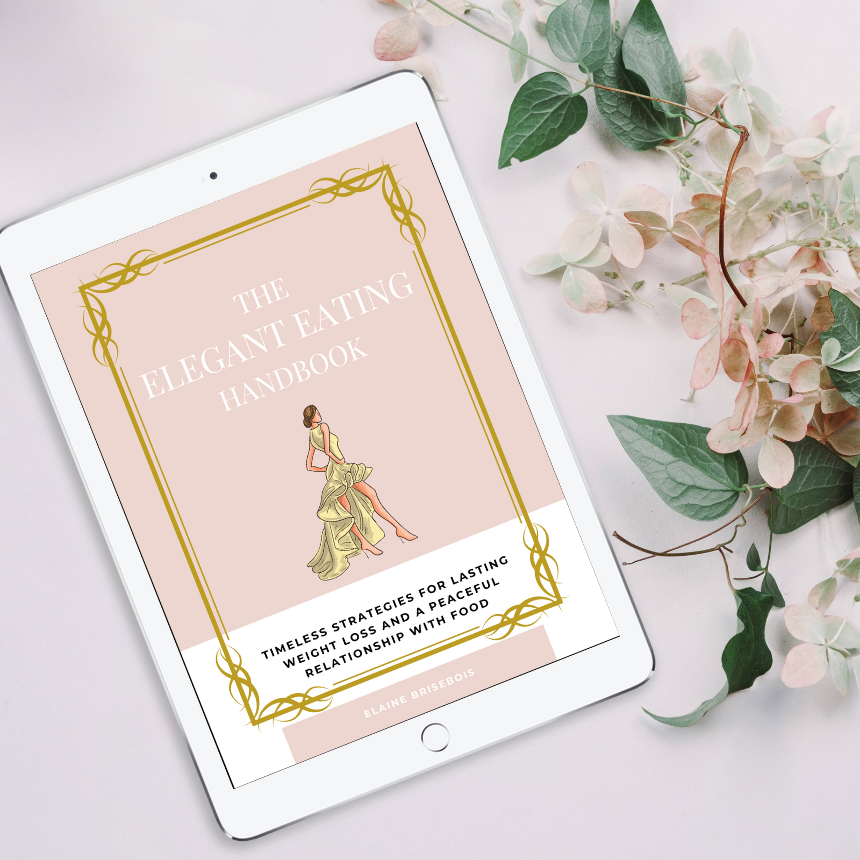
Get a free copy of my handbook!
The Elegant Eating Handbook: Timeless Strategies for Lasting Weight Loss and a Peaceful Relationship with Food.
share with friends
keep reading...



[…] ← Previous […]
[…] And the best way to be really precise, in most cases anyways, is for them to write down exactly what they’ve eaten at the end of the day in a simple food journal. […]
[…] I’m re-visiting a topic that I’ve discussed here on the blog before, but I want to shed more light on the subject, or perhaps a new […]
[…] Tracking food intake and how it affects your energy or digestion […]
[…] I’m revisiting a topic I’ve covered before—but this time, with a fresh […]